
Life as a payment method
MTG Life cost in points are sometimes used as an additional payment to mana. This supplementary cost diminishes the mana cost required to cast a particular spell but will almost never be the only casting cost of a spell.
The rules first, in a line each
Can you pay life below zero? No. You may pay an amount of life only if your life total is at least that much — so you can pay down to exactly zero, and the game ends the next time state-based actions are checked (rules 119.4 and 119.6). Paying 0 life is always allowed (119.4b).
Is paying life the same as losing life? Yes, and the rules say it in as many words: the payment is subtracted from your life total, “in other words, the player loses that much life” (119.4). Anything that triggers on losing life triggers on a payment. It is not damage, so damage prevention does nothing about it.
When can you pay life instead of mana? Only where a cost says so. The general case is the Phyrexian mana symbol: one mana of its colour, or 2 life (107.4f).
And the question the rules do not answer: what that price is actually worth. That is the rest of this chapter.
Listen instead · Part 4 — Resources: cards and life
Narrated by AI from the text of this chapter. All episodes
Why? The reason can be summarized as follows: paying in life points, unlike paying in mana or cards, does not involve giving up the position on the battlefield, at least in the early stages of the game. A spell that costs X mana to cast usually forces us to wait X turns or more before we can cast it. In other words, its inclusion in the deck involves giving up the chance to cast it early-on for future benefits (casting a powerful spell at a later stage of the game). As already mentioned, it is an investment for the future.
A spell that costs X cards to cast prevents us from using these cards later; therefore, it also involves sacrificing the position on the battlefield, in this case in the future. Life points, by contrast, do not require sacrificing a battlefield position at present or in the future, as long as you have enough of them.
In order to clarify this important point, I will use this example
Example:
Take an imaginary 4/4 creature that benefits from several alternative casting costs. It costs 5 mana or 3 cards that the player must discard from their hands or 10 life.

Suppose the player draws this card in her starting hand. If the player wishes to pay the cost of casting the card with mana, she will have to wait at least 5 turns to do so. The waiting time is the price the player has to pay for the card, and this waiting involves giving up the services of that creature on the battlefield at the moment.
Now, let’s assume that the player chooses to save herself the waiting time by sacrificing 3 other cards in her hand. In this case the player gains an advantage in the present but gives up resources that could have affected the table situation in future turns. Yet, paying the cost of the creature in life does not involve giving up the situation on the battlefield in the present or the foreseeable future. The loss of life is not significant because the player is not under threat. His opponent, by contrast, will be under heavy pressure and will have to absorb a lot of damage until she succeeds, if at all, in putting up an effective defense.

Conclusion:
The example clarifies the great advantage inherent in life points as a means of payment. However, this is only true under certain conditions. In advanced stages of the game the opposite is often true: the payment in life becomes many times more expensive, often too expensive, and the cost in mana becomes marginal. To illustrate, let’s say we drew the creature in question when we had 7 lands in play and 9 life.
In this case, the cost in mana is negligible since we have the amount of land required for its casting and we will almost certainly have no other use for it. On the other hand, the cost in life becomes irrelevant, i.e., infinite. Even if we can afford to pay the cost of the card in life, at this advanced stage of the game, it may come at a heavy price. Let’s say that we have 14 life at our disposal at this point, and we pay 10 of them to cast the creature.
Staying on 4 life puts us at a disadvantage in two respects: first, we become vulnerable to spells that inflict direct damage and may lose the game instantly. Second, the low life status deprives us of the necessary flexibility to prevent the opponent from gaining an advantage on the battlefield. The advantage of the defender in MTG relies on the fact that she chooses which of the attackers to block and is able to do so with several blockers at the same time.
Clever blocking:
Clever blocking can turn the tables: get rid of your opponent’s powerful creatures at the cost of your own weaker creatures. This involves giving free passage to one or more of the opponent’s creatures that will inflict damage. In fact, we exchange life for improving our situation on the battlefield. However, if our life status is too low, we lose this advantage. We are forced to block each of the attacking creatures, thus generally worsening our situation. The conclusion is that in advanced stages of the game paying in life involves sacrificing our position on the battlefield while paying in mana does not, the exact opposite of the trend at the beginning of the game.
How should the cost of a card be estimated in life points? What will be considered a ‘good deal’ and how will we recognize an exorbitant price? Here, too, two components of this cost must be taken into account:
The Cost of life that must be paid
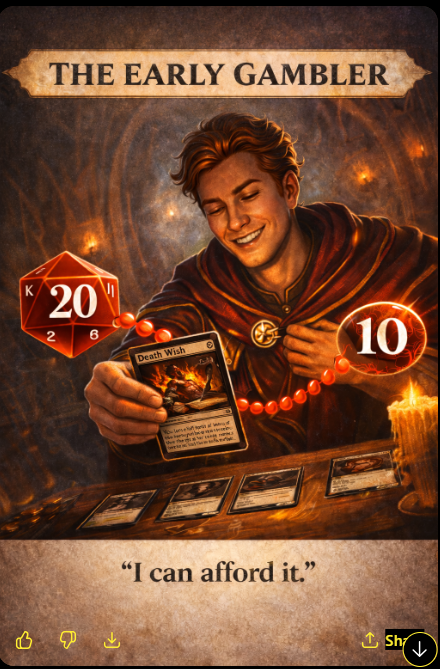
The first consideration is the amount of life that must be sacrificed to use the card. Despite the attractiveness of this payment method, sometimes the cost is simply too high (we lose too many life points) in relation to the benefit we derive from the card. Death Wish, for example, is a black spell from Judgment that allows the player to choose a card from the SB and place it in his hand.
Its mana cost is ridiculous, 3 mana, but it requires that the player sacrifice half his life points. This leaves it far outside the realm of reasonable cards to include in the deck in a limited environment. It is important to note that the calculation of the cost of the card in terms of life is not limited to the cost of casting it. The payment in life may come in the form of a drawback that permanent has while it is on the battlefield, such as losing a certain amount of life every turn or in certain conditions (such as when another creature enters the battlefield). Therefore, the total cost in life that we will have to invest in exchange for the card’s services must be taken into account, and this calculation is not always easy to perform.

Death Wish
mana amount: 3
complexity: 2
The degree of control of MTG Life Cost
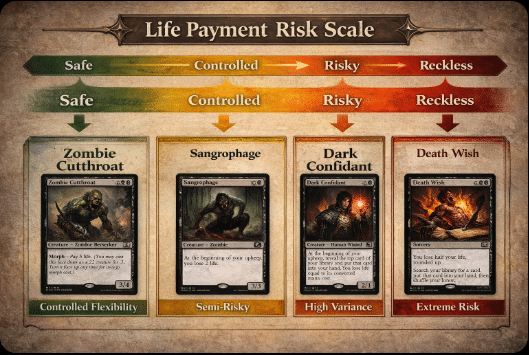
The second consideration is the degree to which the players control the loss of life. If they don’t have such control, using the card may be risky, even if it offers a lot of benefits. The cards can be divided into three categories in this respect:
*Lack of control – cards that, once cast, charge the player a certain amount of life given certain conditions (once per turn, when a creature enters the battlefield, when the player draws a card, etc.) without the player having control over these conditions or the ability to give up the card’s services (by sacrificing it).
The fact that there is a degree of gambling in using these cards does not necessarily mean that these cards are bad. Dark Confidant, for example, is an excellent card that frequently appears in constructed decks. However, the gambling component that characterizes them requires caution, especially if the rate of loss of life is high.
*Control involving the loss of the card – cards in this category give the player control over the loss of life, but the decision to avoid this loss requires practically giving up the card (not casting it, sacrificing it, not using its abilities, etc.). The ability to control the loss of life, even at the cost of losing the card, makes this group less risky compared to the previous group.
*Control that does not involve the loss of the card –
some cards allow a substitute payment instead of the loss of life. This allows their continued use when paying in life is no longer worthwhile. Take as an example the creature named Zombie Cutthroat. This creature can be used in several forms: cast it as a Morph and turn it at the right moment at the cost of 5 life (this is the preferred way to use it, due to the surprise factor); or cast it for 5 mana directly from the hand (it can also be left as a Morph) if giving up 5 life becomes too dangerous. This flexibility greatly increases the value of the card: it allows you to enjoy the advantage that life provides as a form of payment in the early stages of the game, without this becoming a burden in the later stages.

Dark Confidant
mana amount: 2
complexity: 1

Sangrophage
mana amount: –
complexity: 2

Zombie Cutthroat
mana amount: 5
complexity: 2
So many ways to lose your life
Life Payment Components Summary
| Component | Description |
| Amount of Life Paid | Weigh the life loss against the card’s benefit. High-cost examples like Death Wish may be too risky. Total cost may include continuous life loss during use. |
| Degree of Control: No Control | Life is lost automatically under conditions you can’t manage (e.g., Dark Confidant). High reward but inherently risky. |
| Degree of Control: Control by Losing the Card | You can avoid life loss by not using the card or sacrificing it. Safer than full lack of control, but comes at the cost of losing the card’s effect. |
| Degree of Control: Control Without Losing the Card | Cards like Zombie Cutthroat offer optional life payment (e.g., morph for 5 life or hardcast for 5 mana). Lets you choose safer options later in the game. |
Practise this
Life is the tempting currency, which is exactly why it is the one to spend first. The deck auction asks you to buy four decks with nothing but your opening hand and your life total, and to work out each time how little you can get away with paying. The rest of the exercises are under Exercises.
Practise it here
